Leadership often asks us to look beyond what’s being said—at what the environment is reinforcing, how work is actually getting done, and whether people have the space to think clearly. Because over time, those factors become the definition of what matters.
Each story isn’t just a headline—it’s a view worth bringing into focus.
April 2026 / Issue 6
When the Environment Becomes the Definition of Value
A few years ago, Payless ShoeSource ran an experiment.
They rebranded their discount shoes as a luxury label, placed them in a high-end retail setting, and invited people to evaluate them. The same shoes, previously overlooked, were now described as high quality, well-designed, even impressive.
Nothing about the product changed. Only the context did. People weren’t evaluating the shoes themselves, they were interpreting what the environment suggested those shoes were worth.
The leadership perspective: What that experiment revealed in a retail setting shows up in organizations more often than we realize. In any team, people are constantly learning what matters. Not just from what’s said, but from what’s reinforced.
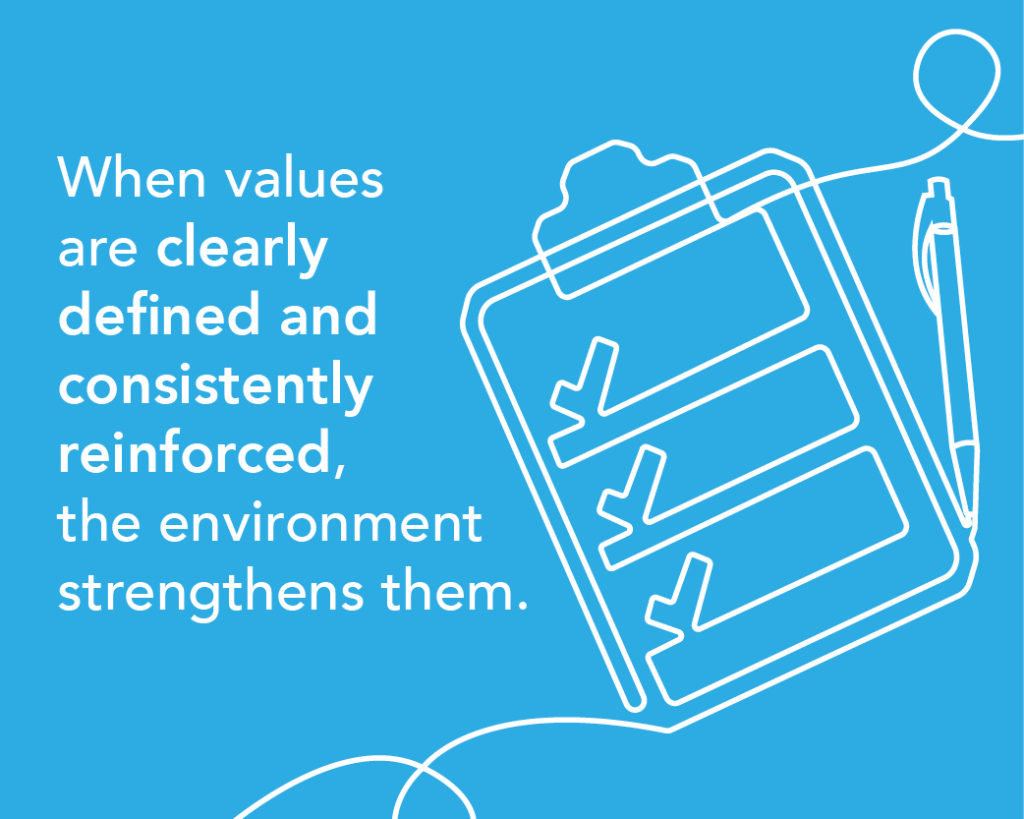
That reinforcement lives in the environment: what leaders respond to, what gets attention, what moves forward, what gets questioned, and what gets repeated. Over time, those signals become the working definition of value. When values are clearly defined and consistently reinforced, the environment strengthens them.
When they aren’t, the environment fills the gap.
Why it’s worth zooming in: Most organizations can name their values. The harder question is whether the environment around the work actually reflects them. When there’s a gap, people don’t ignore it, they resolve it.
So a company might say it values:
- Long-term thinking—but consistently rewards speed
- Candor—but conversations move more easily when people agree
- Ownership—yet key decisions are still pulled upward
- Quality—while fast turnaround is what gets recognized
None of this is usually intentional. But over time, patterns like this send a clear message about what actually matters. And people adjust accordingly.
Not because they don’t care about the stated values, but because they’re paying attention to how things really work. That’s often how values drift. Not through disagreement, but through inconsistency.
How leaders can sharpen focus: Developing capacity often begins by unlearning a few common instincts.
- Revisit your core values regularly and define what each one looks like in real decisions, not just in principle
- Look at what has been rewarded or moved forward in the past few weeks, and ask what that is signaling to your team
- Pay attention to your immediate reactions in meetings, especially what you respond to quickly or positively
- Notice where there is a gap between what you say matters and what your team experiences day to day
A simple way to test this: If someone new joined your team tomorrow, what would they say your organization truly values based on what they experience?
When AI Starts Making Work Harder to Think Through
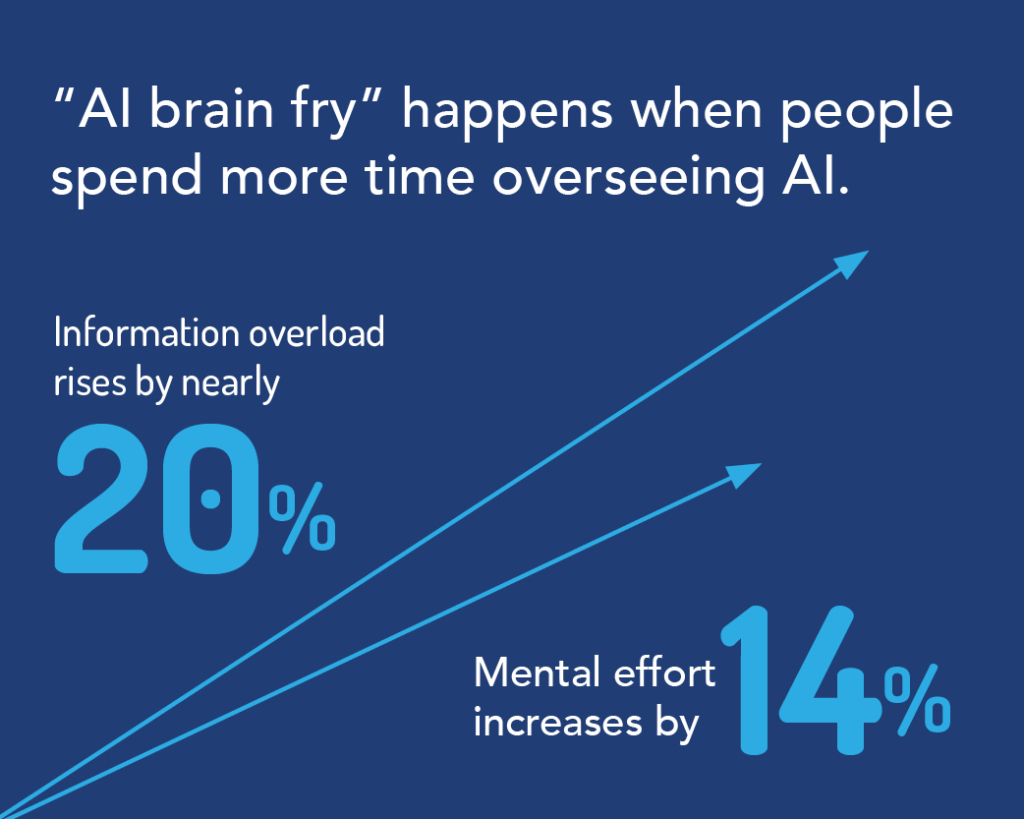
A recent Harvard Business Review article explores how AI is changing the experience of work. While these tools promise to make work easier, workers using these tools often report the opposite. Work feels more intense and harder to keep track of. One study found that when people spend more time overseeing AI, mental effort increases by 14% and information overload rises by nearly 20%. Researchers have started referring to this pattern as “AI brain fry.”
Not because the work itself is harder, but because more of it now lives in managing what’s been produced.
The leadership perspective: In many organizations, AI is being introduced as a clear productivity win. Faster output, better efficiency, more done in less time. But the research points to a different shift. The work isn’t always being removed. It’s being redistributed. Instead of spending time creating, people are spending more time reviewing, checking, and making sense of multiple outputs. The exhaustion isn’t coming from the work itself, but from managing the work.
That changes what the role actually requires. The ability to focus, prioritize, and stay clear in the middle of competing inputs becomes more important than speed alone.
Why it’s worth zooming in: Most teams won’t immediately question this. Output is still moving. In some cases, it’s increasing. But something else starts to happen underneath that. People reread the same content multiple times, second-guess decisions that used to feel straightforward, or lose clarity halfway through something that should be simple. Not because they lack capability, but because their attention is constantly being pulled in different directions.
And attention isn’t unlimited. When it’s stretched too thin, the quality of thinking starts to shift.
How leaders can sharpen focus: Development becomes most useful when it moves beyond individual optimization and into how people contribute and connect with others. A few small shifts can help keep development grounded in real relationships and shared work.
- Be clear what work AI is replacing. If people are still doing the original work and reviewing AI output, the workload has increased.
- Notice where work is slowing down. If decisions require more checking, reworking, or second-guessing, something is adding noise.
- Look at how many inputs people are managing at once. More tools and outputs often mean more time spent keeping track, not moving forward.
- Create moments for teams to pause and align before moving ahead. Without that, people keep producing without clarity.
- Pay attention to where people are spending time. If more time is going into reviewing than deciding, the work has shifted.
A simple way to test this: Where is time actually being saved and where is it being spent managing the output?
Why a Few Minutes of Reset Might Matter More Than We Think
Here at Stop At Nothing, we talk about meditation a lot. Not because it requires mastery, but because it doesn’t. Most people assume it takes time, the right conditions, or that you’re supposed to feel calm the moment you start. Something closer to sitting still on a mountaintop than something you can do in the middle of a workday.
But a recent study co-led by Harvard Medical School found that measurable changes in brain activity can happen in just two to three minutes of breath-focused meditation—even for complete beginners. You don’t need to be good at it. You don’t need perfect conditions. Sometimes all that’s needed is a few minutes of willingness to pause.
The leadership perspective: In most organizations, focus is treated as something people should be able to sustain through effort alone. People move from one meeting to the next, one task to another, with the expectation that clarity will carry across the day.
But the research suggests focus is not just about effort. It is also about state. Within minutes, brain activity begins to shift away from patterns associated with stress and high mental activation and toward what researchers describe as more relaxed, focused alertness.
That distinction matters. The goal is not to make people less engaged. It is to help them return to a state where clear thinking is more available.
Why it’s worth zooming in: Most teams don’t think about focus this way. If someone is distracted or scattered, the assumption is usually that they need to concentrate harder or manage their time better.
But the research points to something more fundamental. The brain does not stay in one mode all day. It moves between states, and those states shape whether someone feels tense and mentally overactive or calm and able to focus. What this study suggests is that even a brief pause can begin to shift that state.
That matters because many workplaces are built around constant mental output, with very little space to reset. But clear thinking is not just about staying on. It also depends on knowing how to come back to a steadier state.
How leaders can sharpen focus: This doesn’t require a long practice or perfect conditions. It can be as simple as taking a few minutes between tasks to reset.Before moving from one meeting or decision to the next try this:
- Set a timer for three to seven minutes.
- Step away from inputs and close down all tabs (mentally or physically).
- Let your attention settle to an anchor, like noticing your breath.
- If your mind wanders, say “wandering”, then come back to the breath.
You don’t need to be good at it and you don’t need to suddenly feel like a calm, zen Buddhist monk. All you need is is a few minutes to pause to begin to move the brain into a state that supports clearer thinking.
So here’s our challenge: Before you move on to your next task…try it!