
When people want answers, leaders can feel pressure to provide certainty. When everyone agrees, we can assume alignment. And when an issue seems small, addressing it can feel less urgent than moving forward. This month’s Leadership Lens looks at three moments leaders can easily misread—and how to respond with greater clarity and intention.
Each story isn’t just a headline—it’s a view worth bringing into focus.
August 2026 / Issue 10
When People Want Answers You Don’t Have
AI is forcing leaders to answer questions that do not have clear answers yet. What will jobs look like two years from now? Which skills will matter? Where will people fit as the work changes?
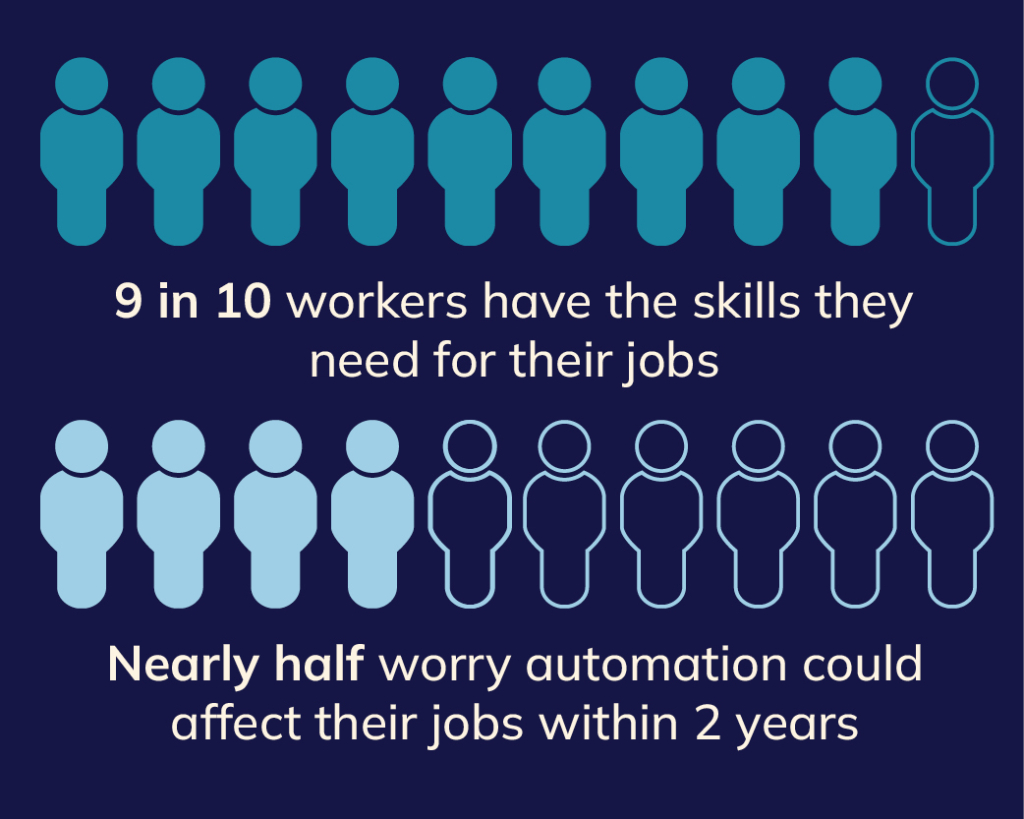
Recent ManpowerGroup research captures the tension. Nearly nine in ten workers believe they have the skills they need for their jobs today, yet almost half worry automation could affect those jobs within the next two years. More than half also report receiving no recent training or mentoring. The uncertainty is not only about whether people can do their jobs today. It is whether they can see a place for themselves in what comes next.
| The leadership perspective:
When people want answers, leaders can feel pressure to have them. And that pressure can quietly change how we lead. We reassure before we have evidence. We speak with more confidence than the situation warrants. Or we avoid the conversation until we have something definitive to say.
The question worth examining is whether we have confused being a confident leader with being a certain one.
You can say “I don’t know yet” without leaving people directionless. You can be honest about what is unresolved while helping people understand what you are watching, what you are learning, and where they can begin preparing.
| Why it’s worth zooming in:
AI makes this tension especially visible, but it is hardly unique to AI. A restructuring, new strategy, market shift, leadership change, or unexpected disruption can put leaders in the same position: other people are looking to us for certainty at precisely the moment we have the least of it.
How a leader responds in that moment matters. Trying to eliminate uncertainty can lead to promises we cannot make. Avoiding it leaves people to fill in the blanks themselves.
There is another option: help people build confidence without pretending the uncertainty is gone. ManpowerGroup CEO Becky Frankiewicz argues that people want to understand how work is changing, where opportunities are emerging, and whether investing in themselves today will create possibilities tomorrow. That gives leaders something meaningful to work with even when they cannot provide the whole map.
| How leaders can sharpen focus:
- Notice your instinct to resolve uncertainty. Before reassuring, ask whether you are responding to what your people need or to your own discomfort with not having an answer.
- Be precise about what you know. Separate decisions that have been made from possibilities still being explored.
- Give people something they can move toward. Share what is changing, what capabilities may matter more, and where opportunities could emerge.
- Keep unfinished conversations open. If an answer does not exist yet, say what you are watching and when you will return to the conversation.

When Everyone Says Yes, But Means Something Different
Leadership teams often assume alignment because no one is openly disagreeing.
The meeting ends. The decision is made. Heads nod around the table. Everyone leaves believing they are moving in the same direction.
But research highlighted in Harvard Business Review suggests something more complicated. Teams can behave as if they agree on why a change is necessary, what exactly needs to change, and how it should happen—while holding very different assumptions underneath that apparent agreement.
| The leadership perspective:
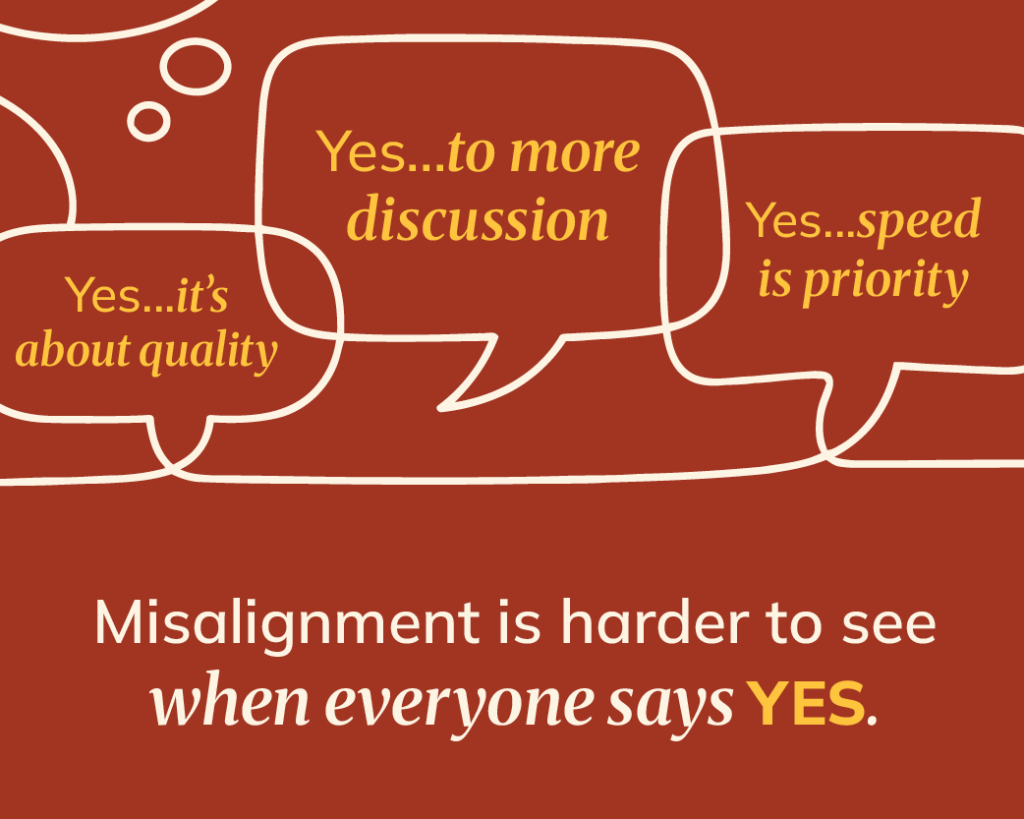
Disagreement is easy to recognize when someone says no. Misalignment is harder to see when everyone says yes.
A leader may hear agreement and assume shared understanding. But one person may believe the priority is speed, another may believe it is quality, and someone else may believe the decision is still open for interpretation.
The issue is not that people are being dishonest. Often, teams have simply moved to agreement before making their assumptions explicit.
That is where false alignment becomes dangerous. The conflict does not disappear. It gets postponed until execution, when different interpretations begin showing up as competing priorities, inconsistent decisions, or frustration about who was supposed to do what.
| Why it’s worth zooming in:
Leaders often try to create alignment by getting everyone to a decision. But a decision can hide disagreement just as easily as it resolves it.
The absence of debate may even feel efficient. Yet the research suggests that vague conversations, pressure to move quickly, and avoidance of disagreement are some of the conditions that allow false alignment to take hold.
The slower work may need to happen before the decision: making people say what they think the problem actually is, what success looks like, what tradeoffs they are willing to make, and what they believe they are agreeing to.
Sometimes the fastest way to execution is to spend more time discovering where the team is not yet aligned.
| How leaders can sharpen focus:
- Ask people to define the decision in their own words. Differences in interpretation often become visible immediately.
- Surface disagreement before asking for commitment. Make it safe to challenge the why, what, and how before the team moves forward.
- Get specific about tradeoffs. Alignment becomes clearer when people have to say what they are prioritizing and what they are willing to give up.
- Confirm ownership after the decision. Make sure people agree not only on what was decided, but on who owns what happens next.

When a Pebble Becomes a Blister
While walking the Camino de Santiago, Stop At Nothing’s Ceci Calderón felt a pebble in her shoe.
She knew it was there. She also knew what getting it out would require: stopping, taking off her pack, finding somewhere to sit, unlacing her shoe, and then getting everything situated again before continuing. So she made a calculation many of us make in different forms: I can deal with this a little longer.
She kept walking.
In an article reflecting on what the Camino taught her about leadership, Ceci describes walking several more miles before the irritation finally became painful enough to stop. The pebble came out easily. The blister it had created stayed with her for days.
It’s a small story about a very human calculation: I know this is bothering me, but dealing with it right now feels more inconvenient than living with it.
And leaders make that calculation all the time.
| The leadership perspective:
Leaders make versions of this calculation all the time. A behavior is frustrating, but not disruptive enough to address. Tension between two people is noticeable, but the team is still functioning. Someone misses an expectation, but there is a reasonable explanation. A difficult conversation can wait.
And often, waiting feels like the easier choice. Addressing something requires time, discomfort, and attention that could be spent somewhere else.
But there is a difference between deciding something does not need our attention and deciding we would rather not give it our attention.
That distinction matters. What begins as a small issue can quietly start affecting trust, performance, relationships, or the rest of the team while a leader is waiting for it to become “important enough” to address.
| Why it’s worth zooming in:
Ceci’s pebble was easy to remove. The blister it created was much harder to manage.
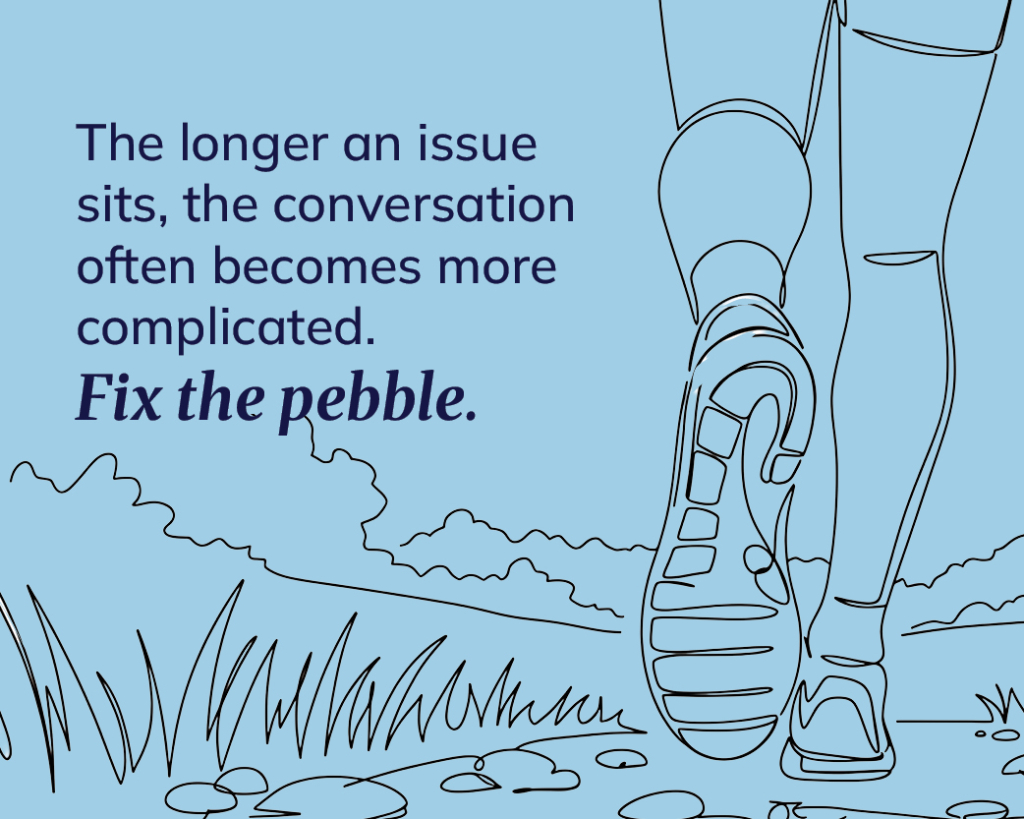
The same can happen at work. The longer an issue sits, the conversation often becomes more complicated. Now there is history to unpack, frustration that has accumulated, other people who may have been affected, or a pattern that has become harder to change.
This does not mean every irritation deserves intervention. Part of leadership is knowing what to let go. But when the same issue keeps getting your attention, perhaps the question is no longer whether it is big enough to address. It is what continuing to carry it might cost.
| How leaders can sharpen focus:
- Pay attention to what keeps getting your attention. A recurring irritation may be telling you something worth examining.
- Separate “small” from “uncomfortable.” Would you still consider the issue insignificant if addressing it were easy?
- Consider the cost of waiting. What could become harder to repair if nothing changes?
- Have the smaller conversation. Addressing something early can allow for curiosity and course correction before frustration and consequences accumulate.