
Why knowing better doesn’t make us immune to the stories we create
By Cecilia Calderón – October 2026
Several years ago, when I was working in the corporate world, I was leading a project that was very dear to my heart. My team and I had invested countless hours in it, and it was finally time to present our work to my peers and my leader.
I walked into the conference room excited. I cared about the work, believed in what we had created, and wanted to deliver a strong presentation while staying connected to the people in the room. Then I noticed the colleague sitting directly across from me. He was rolling his eyes. Not once. Repeatedly.
And just like that, part of me left the presentation.
Why was he doing that? If he didn’t understand something, why wasn’t he asking a question? Did he disagree with what I was saying? Did he think this whole thing was ridiculous? Within minutes, I had answers. He didn’t trust me. He didn’t value me. He didn’t think the work was important. And the remarkable thing about the stories we create in moments like these is how quickly they stop feeling like stories.
Mine felt like facts.
By the end of the presentation, I was upset. I had spent months working on something I cared deeply about, yet one person’s eye movement had managed to pull my attention away from the work, the rest of the audience, and the experience I had wanted to create.
During the break, I finally caught myself and said in my mind, Cecilia, use your tools. So I walked over to him.
“I wanted to check in. Why didn’t you ask me any questions when you clearly didn’t like the presentation?”
He looked genuinely confused. “What are you talking about?”
I told him I had watched him roll his eyes throughout the presentation. Then he explained. He thought the presentation was great. He hadn’t asked questions because he didn’t have any. He also had terrible allergies. His eyes had been itching throughout the presentation, and because scratching them made the irritation worse, he had been moving his eyes around trying to get some relief.
That was it. His eyes itched.
The distrust. The dismissal.The judgment about my capability and the work my team had done? That part had happened entirely inside me. What actually happened was not the same as the story I told myself about what happened. Yet for the better part of that presentation, I had believed every word of it.
Even when we know better, our old patterns can take over
There is an almost embarrassing simplicity to this story. I knew better.
By that point in my life, I understood the difference between facts and interpretation. I knew how quickly the mind fills in missing information. I had the tools to question my own thinking. And my mind did it anyway.
That’s the part I’ve come to find much more interesting.
We tend to imagine growth as a progression in which enough awareness eventually makes us immune to our old patterns. We recognize something, work on it, develop better tools—and somewhere along the way expect ourselves to stop getting hooked.
But that isn’t necessarily how it works.
Anyone who has trained a dog knows this. The dog knows how to sit. The dog knows how to stay. It has followed the same command hundreds of times. Then a squirrel appears, and suddenly everything else disappears. The squirrel has its full attention.
That’s what happened to me in that conference room. My colleague’s eye movements were my squirrel. One moment I was focused on delivering a presentation, and the next I was chasing an elaborate story about what he thought of me.
The training hadn’t disappeared. I hadn’t forgotten everything I knew about how the mind works. Something had simply captured my attention before I could catch myself.
Growth isn’t never chasing the squirrel.
It’s noticing sooner that we’ve left the path.
The space between what happened and what happens next
Looking back, what mattered most that day wasn’t that I created the story. It was what happened before I had the chance to turn that story into behavior. Because I could have left the conference room believing every word of it. I could have become cooler toward my colleague. Less trusting. More guarded the next time we worked together. And from his perspective, my behavior would have changed for no apparent reason.
That’s where something private begins to become consequential. Not because having an interpretation is inherently problematic, but because unchecked interpretations have a way of becoming relationship dynamics.
One person decides what another person’s silence means. Someone interprets a short email as irritation. A leader reads hesitation as resistance. A team member decides they have been left out intentionally. Then people begin responding not only to what happened, but to what they have decided happened. That’s how a story in one person’s head can eventually become something everyone in the room has to deal with.

The three layers of a story
Looking back, I can see three things happening in that conference room. They were so closely intertwined in the moment that I experienced them as one reality. But they were actually three very different things.
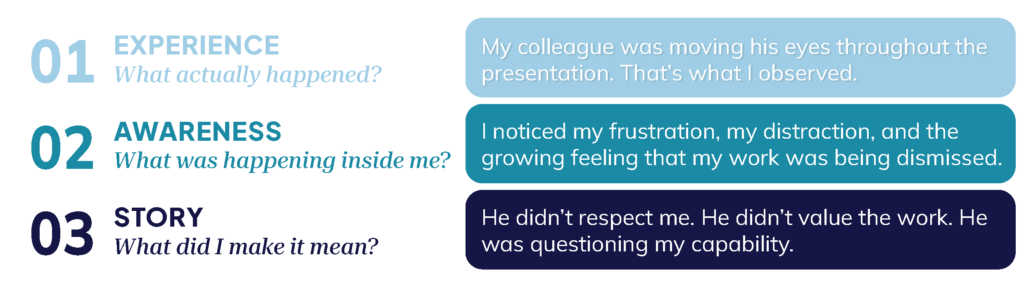
All three felt equally real in the moment. But only one described what was actually happening across the table.
And that’s where one more question becomes important:
Do I actually know my story to be true?
The question that changed everything wasn’t whether my feelings were justified. It was whether I had enough information to believe the explanation I’d created. That day, finding out meant walking across a conference room and asking an imperfect question. And thank goodness I did.
The squirrels don’t disappear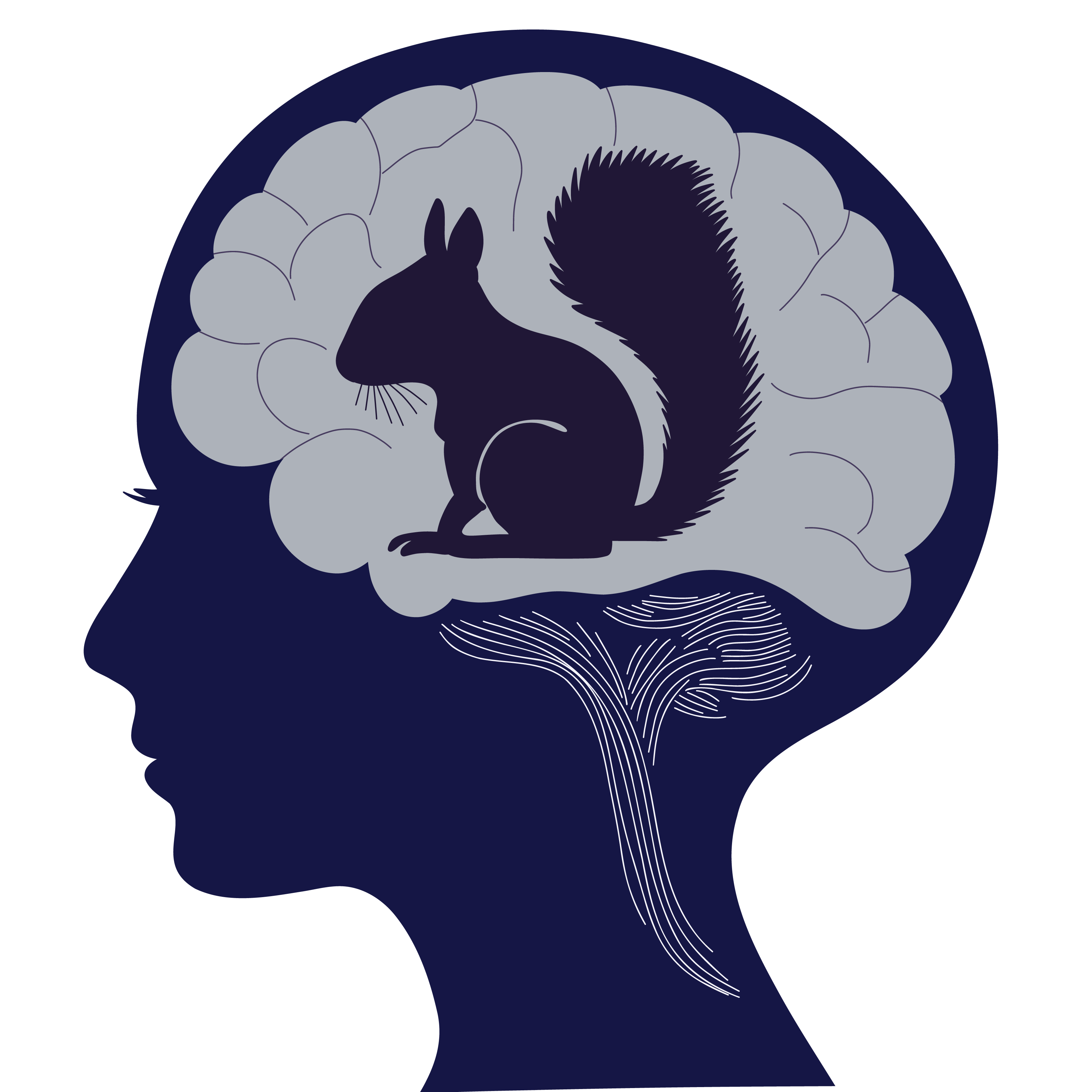
There is another story I’ve had to become suspicious of over the years: I should know better. For people who have spent years doing this work, that one can be particularly convincing. Surely, after enough reflection, feedback, coaching, growth, and self-awareness, we shouldn’t still find ourselves caught by the same things.
And yet we do.
It’s part of why this work remains so central to what we do at Stop At Nothing, including in our High Impact Leadership Seminar (HILS-1). Understanding our patterns is important, but learning to recognize them while they’re happening is where the real work begins.
Perhaps that’s not evidence that the work hasn’t worked.
Perhaps the evidence is in what happens next.
I still think about that conference room sometimes. Not because I can’t believe I made an assumption about someone, but because of how completely I believed a reality that existed only in my own head. For a little while, I was absolutely certain I knew what was happening across that table. I didn’t. His eyes just itched.
There will always be squirrels.
There will always be squirrels. Things that capture our attention and send our minds running before we even realize what’s happening.
I’m less interested these days in whether my mind takes off after one.
I’m much more interested in how quickly I realize I’m chasing it.
