By Rachael McCann – May 2026
Nothing makes you reflect on leadership, relationships, and the pace of life quite like a milestone that suddenly stops you in your tracks.
Sometimes it is a birthday. Sometimes it is a wedding, a grandchild, an anniversary, a new beginning, or the realization that life has quietly been moving along while you were busy living it.
It is one of those moments where you hold two truths at once: one second your whole body cringes, and the next you feel strangely liberated. Maybe you have felt that, too. Milestones have a way of doing that to us. They remind us that life can feel slow and fast at the very same time. The years move quietly in the background until suddenly they are standing right in front of us, asking for our attention.
And there we are, trying to find the pause button.
But if there is one thing I have learned in life, it is that we can find places to pause only if we are willing to take them. We can take inventory, take stock, and get curious about where we are, what we have given, what has shaped us, and what still needs our attention.
Curiosity, I have found, is the antidote to rushing past your own life.
Taking Inventory
When I slow down long enough to look honestly at mine, I do not find one clean storyline. I find a milestone birthday – turning 60, a 35-year marriage, a daughter becoming a mother again, a son preparing to get married, a second grandchild on the way, and fifteen years of meaningful work with my Stop At Nothing family.
I find joy and grief, pride and regret, lessons I chose and lessons I would not have volunteered for. I find people who have loved me well, challenged me deeply, disappointed me, forgiven me, and helped me become more than I would have become on my own.
And somewhere in all of that, I find grace, not as a word to embroider on a pillow, but as a way of surviving the beautiful, frustrating, humbling reality of being human with other humans.
Grace, but Not the Fluffy Kind
The textbook definition of grace can mean elegance, refinement, or pleasantness, but the grace that has become most meaningful to me is something much deeper.
If you live long enough, love long enough, work long enough, parent long enough, lead long enough, or simply try to become a decent person over time, you eventually learn that people are complicated, and so are you.
We all bring our best intentions into rooms where our old patterns are still running. We want to be patient, but we get reactive. Often, we want to listen, but we get defensive. And even when we want to forgive, we still keep score. We want to lead well, love well, and show up well, and then life presses on the tender places we thought we had already outgrown.
That is where grace has become most meaningful to me – not when everything is calm or everyone is behaving beautifully, but in the moments when I would rather judge and choose not to. When I would rather be right, but I give others space to learn instead. When my first reaction is to protect myself with resentment, anger or scorekeeping and despite that I choose to stay open to understanding.
And I want to be clear: grace is not the same as excusing behavior. It is not pretending something did not hurt, letting people cross boundaries and calling it kindness, or avoiding the hard conversation because we want to be “nice.” Real grace has a backbone. It can tell the truth, name the impact, hold the boundary, and say, “this cannot continue,” while still refusing to reduce a person to their worst moment.
I see this play out in leadership all the time. The healthiest teams are not the ones where nobody ever makes mistakes. They are the ones where people feel psychologically safe enough to speak up and ask for help. They can admit when something is wrong and learn without fear of being shamed or diminished in the process.
Grace, at least in my experience as a leader and workplace culture consultant, creates room for that honesty.
Grace, Empathy, and the Life Skills We Carry
Years ago, when I was going through a difficult time in a personal relationship, one of my colleagues said something I have never forgotten:
“Rachael, remember they are doing the best they can with the life skills they have.”
At the time, I did not receive that as the beautiful wisdom it was.
My first thought was closer to, “Well, it certainly doesn’t seem like it.”
But that sentence has stayed with me, and I have reached for it in family moments, in friendships, in work conversations, and in those ordinary little interactions where someone’s behavior leaves me confused, frustrated, or hurt.
They are doing the best they can with the life skills they have.
That does not mean their best is always enough, that there are no consequences, or that I have to absorb what is harmful and pretend I am unaffected. It simply gives me another place to stand, one that is less reactive, more curious, more honest, and more aware.
From that place, I can usually see more clearly what the moment actually needs. Sometimes the moment calls for compassion, accountability, a boundary, or repair. Other times, it asks me to pause and recognize that the thing I am reacting to in someone else may also live somewhere in me.
That is uncomfortable, and it is also where growth tends to begin.

Recently, I was speaking with a senior leader in the healthcare industry, and without any prompting, they began talking about grace in leadership and organizational culture. One part of the conversation stayed with me:
“When you extend grace to somebody in a period where they may be struggling, or you may not even know what they are carrying, they never forget it. It empowers them to extend it to somebody else. And when people see leaders doing that, they recognize empathy, compassion, and a culture that genuinely values people.”
What struck me most was their reminder that these investments in people are rarely wasted. Over time, they become the moments that build trust, loyalty, resilience, and stronger teams.
I think this is especially important in leadership and team dynamics. When grace and accountability exist together, trust grows stronger because people stop wasting energy protecting themselves and start focusing on learning, collaboration, and solutions.
Why Grace Matters Under Pressure in Leadership
At Stop At Nothing, we talk often about what happens under pressure. Leaders can have the right values, language, and intentions. But stress has a way of exposing our default patterns. The real test is rarely who we are when things are easy. It is who we become when deadlines tighten, tensions rise, communication breaks down, or someone drops the ball.
That is where grace becomes more than a nice idea. It becomes a leadership practice.
I have had several clients talk with me recently about the importance of letting people fail, offering support and resources, and allowing them the opportunity to come back stronger because of it. The most respected leaders are rarely the ones who expect perfection. They are the ones who create environments where people feel safe enough to be honest, accountable, and human.
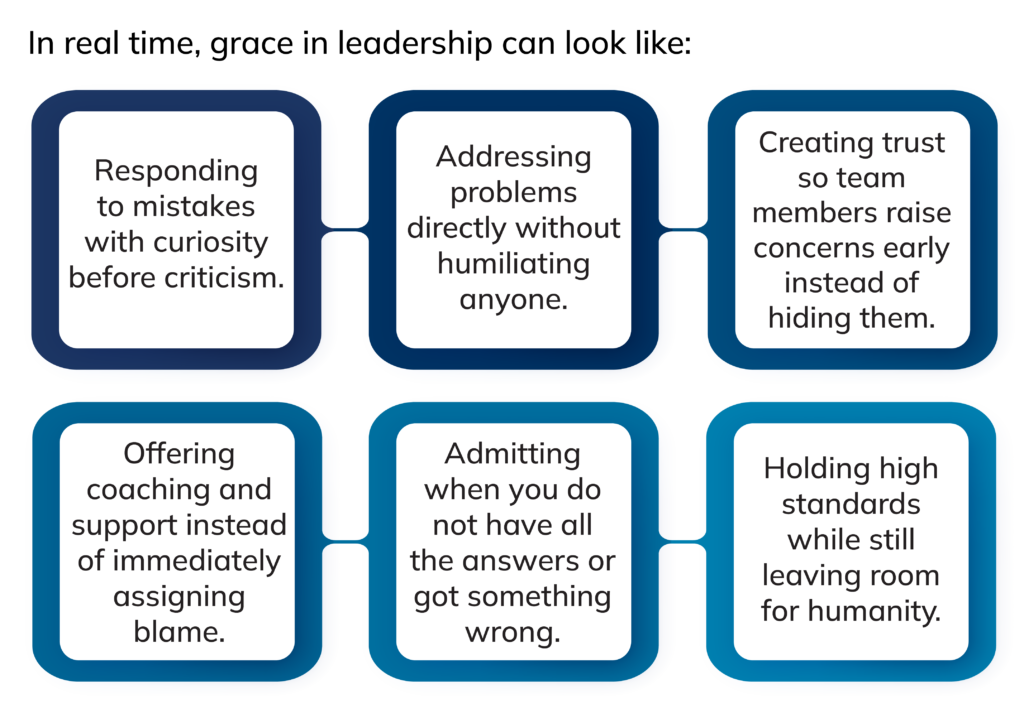
None of this means lowering expectations or avoiding difficult conversations. In many ways, grace asks more of leaders, not less. It requires emotional discipline, self-awareness, accountability, and the willingness to build trust consistently over time.
When Grace Gets Tested
Grace is easy to admire in theory. It is much harder to practice in the ordinary moments when our pride, patience, or sense of fairness gets poked.
It gets tested when:
- Someone disappoints us, and we have to decide whether we are going to address what happened or turn the person into the whole problem.
- We want to interrupt, defend, explain, or correct, and we have to choose whether to listen a little longer because the first version of the story is rarely the whole story.
- Someone makes a mistake, and accountability can either become a path forward or a courtroom for everything they did wrong.
- Our internal scorecard comes out, and we start counting who apologized first, who tried harder, who failed more often, or who owes whom.
- We contributed to the mess and would rather wait for someone else to go first, even though nothing changes the temperature of a room quite like someone willing to say, “Here is the part I own.”
- The person who needs grace is us, and our inner critic gets loud, or we are running on empty, or we cringe at who we used to be before we knew better.
In all of these moments, grace does not mean pretending nothing happened. It means telling the truth in a way that still leaves room for repair. We can name what hurt, what needs to change, and what cannot continue without turning every hard moment into a verdict on someone’s character or our own.
Making Room for Grace
The older I get, the more I realize grace is not something to achieve, it is something to practice in the rooms we are already in.
I would like to think I have become more elegant and refined with age, although my kids would tell you I am still very capable of being clumsy. I also strive to be polite and pleasant, although I do pop my cork from time to time.
But the grace I want more of is not about appearing elegant or pleasant. It is the kind that shows up in the pause before judgment, in the decision to tell the truth with care, in the willingness to hold a boundary without turning cold, and in the choice to remember that everyone around us is carrying more than we can see.
When we practice that kind of grace, we make it a little safer for people to be honest, to repair, to take responsibility, and to try again. That may not change the whole world in one grand gesture, but it can absolutely change the rooms we are in.
If I can keep practicing that, I believe I will show up better as a colleague, partner, mother, friend, and leader.
Notice I did not include grandmother on that list, because that child can do almost anything and still make my heart swell. Maybe that is because children remind us what grace looks like before we complicate it: we expect them to stumble, spill, get overwhelmed, try again, and need help along the way. We make room for their becoming.
Maybe the rest of us need some of that room too.
He gets grace, as my mother-in-love used to say, “all day long and twice on Sunday.”