
Leadership Lessons from the Ballroom Floor
By Cecilia Calderon – March 2026
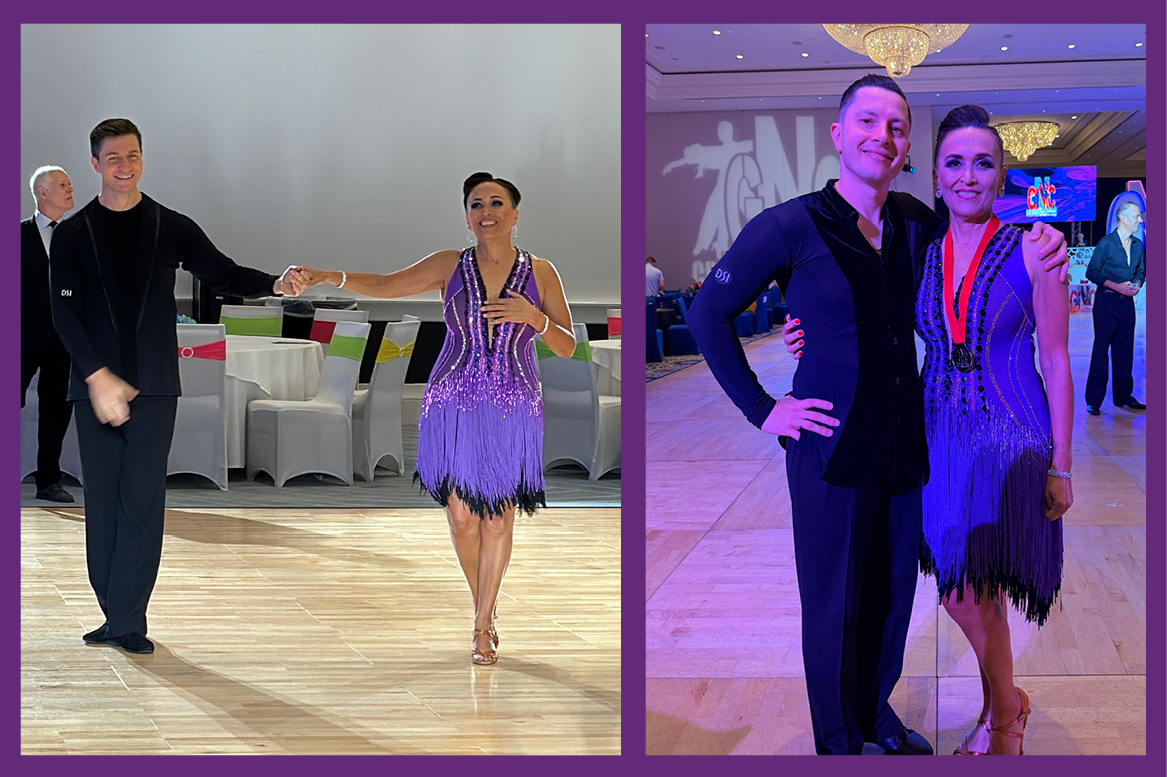
Two years ago, I walked into a ballroom dance studio.
Not because I wanted to build a new skill, impress anyone, or add a hobby to my resume. I went because I felt this nudge — to slow down, connect, find community and rediscover joy.
I had spent years holding space for others, making decisions, solving problems, and pushing forward. Life had become full, demanding, and at times heavier than expected, which has a way of making you notice when fun and presence are no longer things you can afford to overlook.
That’s what led me to the ballroom.
I expected to learn steps. Find joy in dancing with a partner. What I didn’t expect was what the dance floor would teach me. From the very first class, one thing became clear: you cannot think your way into rhythm or connection.
You must feel it.
Practice it.
Repeat it until it lives in you.
That’s when I understood something I’d always believed but never felt so clearly: learning only sticks when it’s embodied.
And the lessons that emerged from that floor surprised me.
The Voice Creeps In
On the dance floor, I started from zero.
I stepped on toes.
Missed cues.
Forgot steps I had practiced five minutes earlier.
And I made mistakes — repeatedly.
No matter how accomplished you are in your professional life, on the dance floor none of that matters. Every time I made a mistake, a voice crept in. The one that whispers that mistakes are unacceptable, that you must get things right immediately, that competence means flawlessness.
Truthfully, there was a time that voice would have walked me right out the door. But growth requires the opposite: the willingness to look awkward, to try, to fail, and to try again. The dance floor quickly exposes that truth. Mistakes are not just inevitable, they are necessary.
They are the pathway to learning, not a detour from it.
My teachers seemed to know this well. When I stumbled or lost the rhythm, one of them would quietly whisper, “Nobody noticed — keep going.” Such a simple thing, but it was exactly what I needed to hear. Because the temptation is always to stop, to fix, to get it right before moving on. But that’s not what dancers do. They don’t stop when something goes wrong. They move through it. They let the mistake get absorbed into the dance, and most of the time, nobody notices.
That’s what mastery looks like. Not avoiding mistakes but becoming comfortable making them, time after time, without losing confidence. And when we can hold that for ourselves, we create space for the people around us to do the same.
Between The Steps
There is something eye-opening that happens with dance. You realize there is always more room to find — and to learn patience. Not with others, but with the most important relationship you have. Yourself.
The mind wants to tell you that progress looks like doing something perfectly, but I’ve learned it is much simpler than that. It’s one turn that flows where the last one didn’t. The beat you feel in your feet instead of counting in your head. A moment of connection with your partner that wasn’t there before. The first time the music and your body finally speak the same language.
Most of the time, you don’t even notice it’s happening.
That’s how transformation works. It rarely announces itself. It doesn’t arrive overnight. It shows up in the small things — long before you can see the full picture.
Pause here for a moment.
Maybe transformation is already happening for you too — but it’s small, so you forgot to notice. Like the moment you listened a little deeper than before. Paused before reacting. Didn’t panic the way you used to. Chose a different word. Let someone else lead.
Small things. Easy to miss. But transformation happening, nonetheless.
Claim Your Space
During one of my waltz lessons, my teacher stopped and looked at me and said “Cecilia — you must be comfortable occupying space.”
I understood exactly what he meant. At first, I noticed the tendency to move carefully, to avoid taking up “too much” space. It had always felt safer to be measured and contained. But dancing does not reward shrinking. If you do not claim your space, the dance loses clarity and impact, and on the dance floor, that hesitation is immediately visible.
Occupying space is not about dominance. It is about grounded presence — standing tall, extending fully, trusting that you belong exactly where you are. Not too much, not too little.
As a woman leader, this is a lifelong calibration.
We are often conditioned to soften our presence.
To avoid being perceived as too assertive.
Too visible.
Too strong.
Too much.
Yet when I step fully into the movement, the partnership works better. And when I claim my voice and my presence without apology, the room settles. Direction becomes clearer. Energy aligns.
Occupying space, I’ve learned, is not only an act of confidence — it’s also an act of courage.
The Courage To Shine
There is something the dance floor demands of you — something more personal than footwork or timing.
It forces you to be seen.
And at some point, usually when you least expect it, you realize that worrying about whether you look perfect is getting in the way of actually dancing. So you make a choice — to stop managing how you appear and simply allow yourself to shine. To move with joy and authenticity. And did I say joy? Because it deserves to be said twice.
This can feel vulnerable, especially for those of us who are used to staying composed and controlled. But shining is not about seeking attention. It is about bringing your full self into the moment. And when you do, something opens up, not just for you, but for everyone around you. People feel it. They lean in. They give themselves permission too.
Somewhere in all of that, it stops feeling vulnerable and starts feeling liberating.
The Conversation Nobody Hears
Of all the things the ballroom has taught me, the dynamic between leading and following was the most powerful.
Contrary to common assumptions, following is not passive.
It requires attentiveness.
Responsiveness.
Trust.
And it demands strength, clarity, and awareness.
Likewise, leading is not about control. It is about providing direction while staying attuned to your partner. It is a continuous dialogue, communicated not through words but through movement and connection.
The best dances happen when both partners are fully engaged, responsive, and supportive of each other. Not one person pulling the other through the steps, but two people in genuine partnership, each one making the other better.
Think about the best partnerships you’ve ever been part of.
The ones where something just worked.
Where ideas flowed.
Decisions felt easier.
People brought their best.
Chances are, nobody was pulling rank. Nobody was forcing alignment. Someone was leading but they were also listening. And everyone else wasn’t just following, they were connecting.
In dance, as in life, as in every team I have ever been part of, everything works better when there is mutual trust.
Where It All Connects
At its heart, ballroom dancing is about connection — with the music, with your partner, and with yourself. Without it, even technically perfect steps feel empty. With it, even the simplest movements become something worth watching.
And isn’t that true of every meaningful thing we do?
The most impactful people I have worked with were never the ones with the most impressive titles or the sharpest strategies. They were the ones who made people feel seen. Who listened deeply. Who created environments where others felt valued and understood. Connection is what transforms performance into meaning.
The Practice
I never expected a ballroom floor to become one of my greatest teachers.
When I first walked into that studio two years ago, I was simply looking for something just for me. What I found was so much more than I anticipated — a reminder that there is a difference between knowing something and having it live in your body. The dance floor didn’t teach me new things. It made me feel them. And that’s the part that stays.
Most importantly, it brought joy back into my life. Not joy as a reward for getting things right — but joy as a source of energy, resilience, and creativity. Something I hadn’t realized I had been running low on until I found it again. And in doing so, I believe it has made me a better leader, consultant, and coach.
I haven’t figured it all out. Some weeks the voice comes back. Some classes I leave feeling like I’m starting over. But I keep showing up. To the studio, to the music, to the stumbles and the small victories.
Because that’s the practice. On the floor and off of it.
With appreciation to Let’s Dance Miami, and to my teachers, Stefan Ilies and Anatoli Vacaru.
