By Jon Patton – July 2026
A few years ago, I picked up a set of juggling balls. The box had a tagline printed across the front: “The art of not dropping a thing.”
I paused. It felt less like a tagline and more like something I’d heard before.
That phrase has followed me into a lot of rooms since. In coaching sessions, retreats, and the conversations that happen after the agenda is finished, I hear the same pressure beneath what senior leaders are saying: nothing can be dropped.
The demands keep multiplying, but the expectation remains the same: keep everything moving. And most leaders have not stopped long enough to notice what that expectation is actually costing them.
The List Nobody Wanted

The pressures are not new. Leaders have always carried a lot. But the combination landing on senior leaders right now feels different in both weight and pace.
The cultural disruption from COVID is still working its way through organizations. Teams that never fully reformed. Trust that never fully recovered. Ways of working that got improvised and then calcified. On top of that, economic uncertainty, restructuring, geopolitical instability, and AI, which arrived not as a future consideration but as something already sitting in the inbox, already reshaping what gets decided, by whom, and how fast.
That is the professional list. Underneath it, the personal one keeps running. Health. Family. Financial pressure. The sense that there is never quite enough of you to go around.
What I notice is that this combination does not just exhaust people. It changes them. Leaders who are normally steady start reacting instead of responding: doubling down when a small adjustment was needed, pulling back when staying the course was right, making sweeping decisions when measured ones would have served better.
The weight is not just adding up. It is changing how people lead.
What AI is Making Harder
Of everything on that list, AI deserves a closer look. Not because it is the biggest pressure, but because of what it does to all the others.
It accelerates them. More inputs arriving faster than anyone can think through them. More expectation to have a view before you have had time to form one.
I was sitting with a senior executive recently and she paused mid-conversation and said, “You know what the hardest part is? It is not the strategy. It is that I cannot hear myself think anymore.”
That is the real cost. As AI takes on more of the analytical load, the human advantage becomes less about processing and more about discernment. But judgment requires something most leaders are running dangerously low on right now: the ability to think clearly when everything around them is loud, fast, and urgent.
What Pressure Actually Does
Think about the last time the pressure really got to you. Not a single hard day, but the kind that builds over weeks or months until it becomes the condition everything else happens inside of.
Notice what happened to you in that period. The patience that shortened. The certainty that got louder. The sense that you were seeing things clearly, and then later, with some distance, realizing you had been seeing them selectively.
That is what sustained pressure does to a human nervous system. What protects us in a genuine crisis quietly undermines us when the crisis becomes the permanent condition.
In Jungian psychology, this is called being “in the grip.” Jung observed that under sustained stress, a person’s least developed qualities tend to take over. The parts of us normally held in check by self-awareness and values stop being held in check. And we act from that place without fully realizing it.
The grip does not feel like a loss of control. It feels like clarity. It feels like necessity. It feels, in the moment, like exactly the right response.
You have probably felt it. The meeting where you left more certain than when you walked in, but somehow less resolved. The email you sent from frustration that you would not have sent from steadiness. The decision that seemed obvious in the moment and looked different the next morning.
The leader in the grip almost never knows they are in it. That is the part that matters most.
What I’ve Seen Change
In our leadership retreats, we create a very different environment from the one most leaders live in. No devices. No constant input. No agenda running faster than the people in the room.
By midweek, something shifts. People start noticing things they had stopped noticing. How quickly they jump to a conclusion before they have finished hearing something. How much of what feels like thinking is actually just reacting.
One leader said to me on the third morning: “I think I have been in a hurry for two years. I did not know that until now.”
Nothing external had changed. But something internal had shifted. Enough room had opened up to see what had been running on automatic.
That is where real change starts. Not from a new framework. From seeing clearly what has been running the show.
A Place to Start
You do not need a retreat to begin this.
There is one practice I come back to more than any other, and I have watched it make a real difference for the leaders I work with.
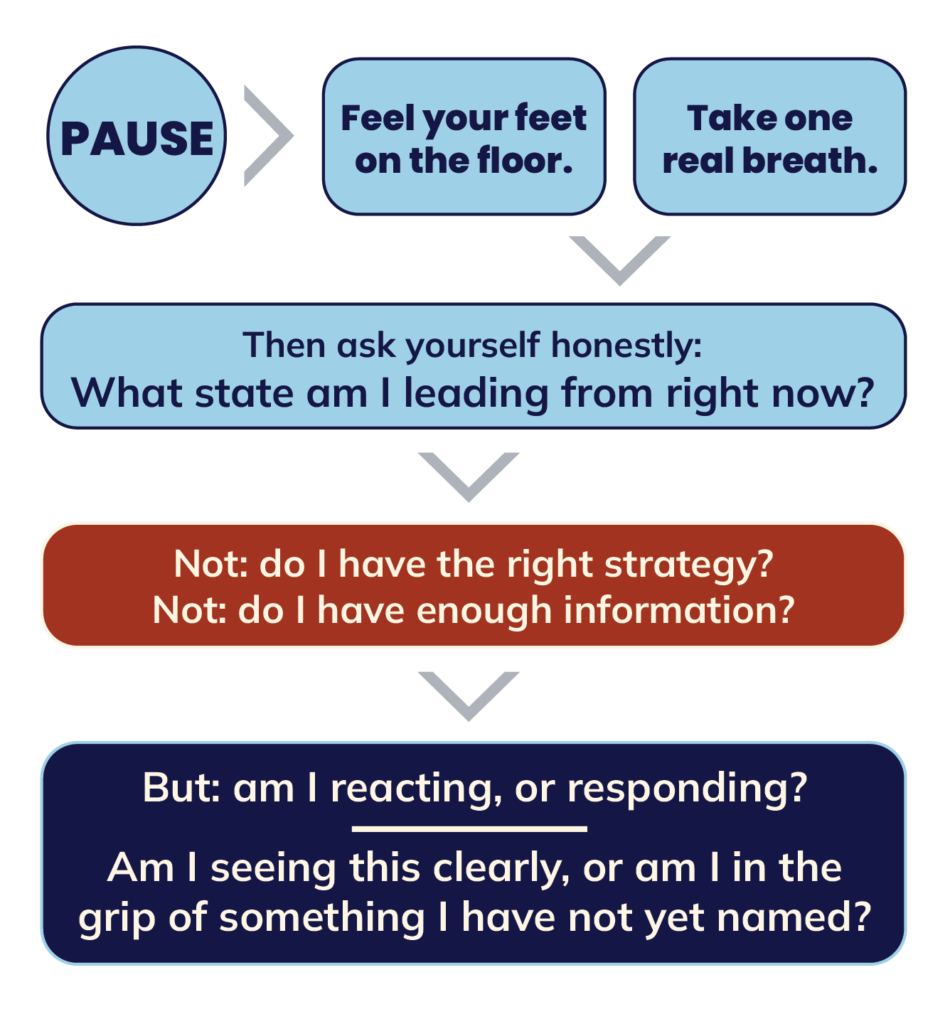
That pause does not solve everything.
But it interrupts the automatic. And interrupting the automatic is where almost all real change begins.
Before your next consequential meeting or decision, take three minutes for a Pressure Check.
Write down your answers to these questions:
1. What is happening in me? Name the physical signal first: tight jaw, shallow breathing, racing thoughts, heaviness, or restlessness. Then name the emotion underneath it as precisely as you can.
2. What is it making me want to do? Under pressure, most leaders develop a predictable reflex: move faster, take control, avoid conflict, overexplain, shut down, or make the decision alone. Identify yours.
3. What does this moment actually require? This answer may be different from what your reflex is urging you to do. The moment may require another question, a dissenting view, a clearer boundary, a delayed decision, or an honest admission that you do not yet know.
Then translate that awareness into one observable action:
• “I will ask the person who has spoken least to go first.”
• “I will identify what we are assuming before we approve this.”
• “I will not make this decision until tomorrow morning.”
• “I will name the tension everyone is avoiding.”
• “I will remove one priority rather than adding another.”
The purpose is not to become calm for the sake of being calm. It is to catch the moment when your internal state begins making decisions on your behalf.
Try the Pressure Check once a day for one week. Keep a brief record of the reflex you noticed and the action you chose instead. By the end of the week, you will begin to see your pattern—and that pattern is where the real work starts.
Closing the Circle
Pressure does not simply make leadership harder. It can quietly change how a leader listens, interprets information, treats people, and makes decisions.
After 25 years of working with leaders, I have learned that the decisive moment often comes before the visible action. It is the moment when urgency becomes control, uncertainty becomes avoidance, or fatigue becomes impatience. Leaders who can recognize that shift have choices. Leaders who cannot are more likely to behave reactively.
That is why awareness matters. Not as an abstract ideal, but as an operating capacity: the ability to notice what is shaping your behavior while you still have time to choose differently.
I have created a short guided meditation to help you build that capacity through daily practice. It is an opportunity to notice your thoughts, emotions, and physical responses without immediately acting on them. Practiced consistently, this awareness becomes easier to access throughout the day—especially in the moments when pressure might otherwise take over.